


Bike Lights? You’re about to go down a rabbit hole. You better bring a light.
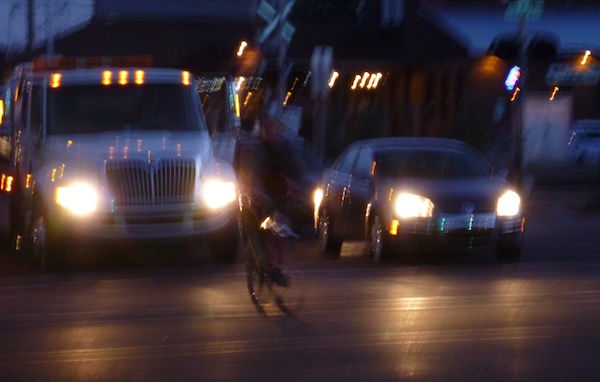
Bike lights serve two functional purposes: (1) help the rider to see in the dark, and (2) help the rider to be seen in the dark. You may even hear cyclists referring to “see lights” and “be seen lights,” because experienced cyclists buy lights for one or the other primary purpose.
To the point: If you buy a “see light” when you only need a “be seen light,” you’ll probably spend too much money. Conversely, if you buy a “be seen light” when you really need a “see light,” you may run into something in the dark that you’ll wish you had seen.
If you’re an urban cyclist who, after dusk, always with street lighting of some kind, you can see just fine by the lights of the city, and will need, at a minimum, a blinky headlight such as the CygoLite ExpiliOn 170, and a tail light like the Cygolite Hotshot to augment your reflectors and compete with all the other flashy distractions on a city street.

If you’re a night-rider who always blazes over unlit roads and trails after dark, a vampire like you needs to flood the road or trail ahead with as many lumens of light as you can afford. With a top-of-the-line headlight like the Light and Motion Seca 1400, you will be lit like a baseball stadium on two wheels.
But unless you are one of the two extremes, you need a blend of both “see” and “be seen.” Are you mostly a city rider, who has occasional dark zones on your night commute? Are you a mountain biker who sometimes gets caught after sundown? When you do ride after dark, how far do you go, and how long does it take you?
You can over analyze choosing the perfect light for your cycling lifestyle. Don’t worry, it’s not that hard. What you don’t want to do is end up too little light when or where you need it. You also don’t want to spend money replacing batteries so frequently that you would have saved money investing in a light of higher quality.

Lumens, Speed, and Reaction Time
Light is measured in lumens (a.k.a. candelas). It takes an alert person about 1.5 seconds to react to something they see ahead of them — although this varies greatly depending on the person and the situation.
A single car or motorcycle low-beam headlight is about 700 lumens. Motor vehicles need bright lights because of their speed. A motorist traveling at 60 mph sees a dog in the road 200 feet ahead, he/she has about two-and-a-quarter seconds to react. A cyclist traveling a 15 mph has nine seconds to react to the same dog. (It could even be a different dog.)
So for a typical bike commuter or casual cyclist a 740-lumen bike headlight, such as the Cygolite Turbo 740, is more than bright enough to help illuminate potential problems in the road, and to give the cyclist time to react — and that’s assuming the cyclist is otherwise in absolute darkness. However a mountain biker speeding down a trail at night needs much more light to have the same level of situational awareness. A commuter could probably spend a little less money and have all of the reaction time he/she will need.
In fact, brighter is not necessarily better for a cyclist who shares the road with cars. Car headlights are somewhat precisely aimed to help the driver see, but also to prevent temporary blindness in people coming the opposite direction. A cyclist with a carelessly-aimed, 740-lumen headlight may cause an oncoming motorist to become even more dangerous.

Flashing Headlights and Tail Lights
Most bike headlights have at least one flashing mode that helps catch the attention of oncoming traffic more than a steady light would of the same or more brightness. This is the “be seen” strategy. These modes have the added benefit of saving battery life — because the bulb may be off more than half of the time. Flashing on and off accounts for the wide variation in battery life of some headlights, such as the CygoLite ExpiliOn 350 USB , which has two hours of battery life in it’s brightest mode, but 24 hours in flash mode.
If you typically ride on a combination of lit and unlit streets, it’s good to have a bright light that easily switches between a bright steady mode, and a flashing mode.
Tail lights pretty much are made for flashing. But simply blinking on and off is for underachievers. The better tail lights, such as the Light and Motion Vis 180 have eye-catching strobe-light patterns that make them stand out from other distractions competing for a motorist’s attention at night, such as lights from other cars, trucks, motorcycles, signal lights, street lamps, and illuminated business signs.
Because tail lights are behind you, it’s easy not to notice when the battery is getting weak. With a rechargeable tail light, a rider who can develop the habit of a weekly recharge, will always have the full effectiveness of the light.

Figuring out the Right Light
- Headlights and Lumens: How much light is a lumen? A single car or motorcycle low-beam headlight is about 700 lumens, and typical high-beam headlight is 1200 lumens. Unfortunately some lights only tell you how many watts of energy they use.
- Battery Life:
- Flashing Patterns:
- Charging and Power Options:
CygoLite: Cygolite makes cutting-edge lights that are tough, dependable and powerful. Cygolite engineers want to enjoy the ride–and there are plenty of options for enjoying the ride.
Light and Motion: Light and Motion has been designing and building bike lights for more than 20 years. All of their products are designed and built in Monterey, California, by riders–bike commuters, mountain bikers, and other types of cyclists.